


This page has been visited
---- I propose that large bipedal dinosaurs walked erect with their tails held aloft, in order to see enemies, food, and mates at a greater distance, to lessen the chance of a predator jumping on their back, and to lessen the chance of tripping.
INTRODUCTION
---- A bipedal posture arose often in dinosaurs and is an indication of an excellent ability to maintain balance. Very few present day vertebrate species other than birds can do so. It is especially characteristic of the dinosaur predators. Jurassic dinosaur predators are often portrayed walking with their bodies held horizontal and their legs vertical [Margottini] as in this site also as well as this one. Cretaceous dinosaurs were portrayed this way also. The neck vertebrae entering the skull from beneath would be indication of a largely upright posture or at least an upright neck. The skull portrayed here shows the vertebrae entering the skull from beneath at about a 45 degree angle if we assume that the first four vertebrae are part of the skull. This last seems likely in view of the thin bones drooping down from the vertebrae. If Velociraptor in life was close to how these bones were oriented, they kept their neck erect like an ostrich and their thigh bone oriented forward, which would have placed their feet under their body if they kept their knees straight. There is some logic to a such a seemingly awkward stance. If they tripped, their body would have to rise some at first, which would have lessened the chance of falling. The orientation of the horizontal canal of the ear balancing organ is parallel to the horizontal plane during normal locomotion, which for Allosaurus suggests that it held its head almost parallel with the horizontal plane during normal walking.
DISCUSSION
---- It would be possible for the dinosaurs to hold their bodies horizontally. However, they could not hold their legs vertically as is usually portrayed. If they tried to do so, they would fall forward and either break their thin ribs or break their fall with that big head and robust neck or their breast bone because their center of gravity would be forward of their hips. This is more than likely true even given the lesser density of their lungs. That their lower jaw was set back a little is an indication that they did use their head to break a fall. Their arms were too small for this and were probably only used to pick up and eat small scraps of meat. Of course they could walk horizontally if they thrust their hips backward. You can verify this by bending forward at the hips.
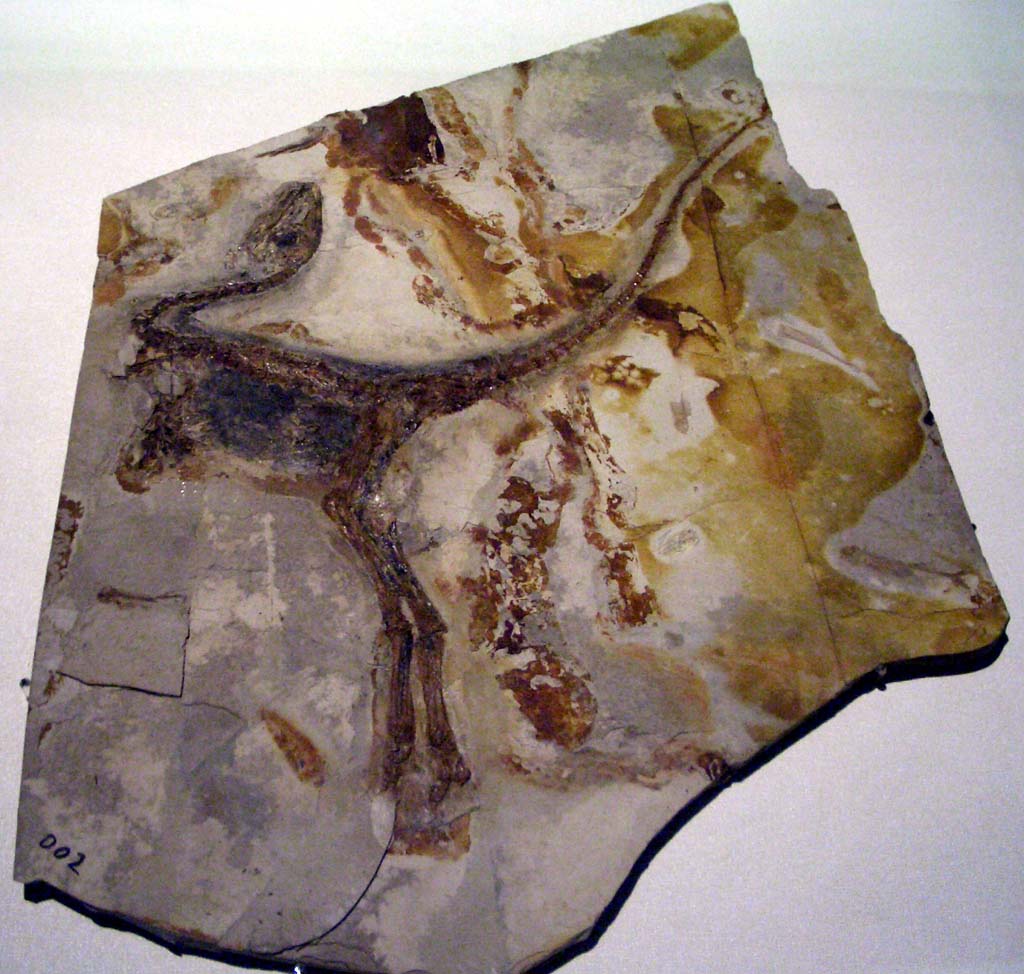
Walking upright has many advantages. It enables better view of mates, food, or enemies and the ability to attack from above. It also makes jumping on their backs more difficult, which was, no doubt, a serious problem. The number of four legged species that developed elaborate bony appendages on their backs is an indication of that seriousness. Some suggest that back plates were primarily a sexual display. But the chance that such structures of expensive bone used for display only would evolve is extremely small. Back plates became prohibitively expensive when the Amitermitinae termites depleted the soil of phosphorus during the Cretaceous. and largely disappeared. That huge tail probably helped considerably with this also because they could prevent a jump on their back from the rear with it. Walking erect also makes tripping less likely because they could then hold that massive tail aloft and then thrust it backwards if they start to trip and even grip the ground with it. Holding the tail aloft is also somewhat more efficient in stabilizing side to side posture. Holding it aloft requires less energy. Holding the tail aloft is advantageous for warding off enemies also. The tip of the tail could probably move with the speed of an arrow, so was a formidable defensive weapon. Even the puny arms of humans can hurl a fist or rock with fairly serious affect and a tail tip was a lot heavier and more expendable than our fingers. The tip of a Dinosaur tail entering an opponent’s eye must have been devastating or even that huge mass hitting an opponent’s ribs. It is very likely that they preferred to keep the tail close to the body, when threatened, just as a modern day boxer keeps his arms close to his body because he can inflict much more damage on an opponent than if his arm is out stretched to start with and can protect his body more effectively. I see nothing in the design of the hip bones that precludes a largely upright posture, say 60 or 70 degrees to the ground or possibly more with the tail elevated upright. Even the small bipeds may have kept the tail aloft if these bones of a Sinosauropteryx is an indication and as this fossil appears to make possible. I suspect that this was how the large bipedal dinosaurs walked. It has been proposed that the tail could bend at least 90 degrees to the body at the base and I suspect the remainder of the tail was fairly flexible also. The way the head is attached to the neck vertebrae seems to indicate an upright posture also, or at least an upright neck.
CONCLUSIONS
When paleontologists mount large bipedal dinosaurs, they will be portraying them much more logically if they do so in a largely upright position and perhaps with their tails held aloft. The small bipeds should have their legs oriented forward and possibly, alternately, the large dinosaurs as well.
Margottini L 2011 Is it time to declutter the dinosaur roster? Science 332; 782.
DINOSAUR ARTICLES
---- Links from the Dinosaur Society, including museum sites, societies, kid’s sites, and miscellaneous.
---- A discussion of the history of Tyrannosaur research and an even more comprehensive discussion of research and Tyrannosaur biology.
---- Descriptions of dinosaur families.
---- Miscellaneous geological links on the world wide web.
---- Links to geological sites at the end of an article that explains the motion of ocean plates.
You may also see a discussion about the dangerous interaction between potassium and vitamin B-1 (thiamin) vs a vs heart disease in this article
You may see a site about aneurisms, hemorrhoids, slipped discs, and high cholesterol as caused by a copper deficiency in this site.
If you are afflicted with tooth cavities or aches, read this article about anacardic acids in cashew nuts, which will cure most of them.
There is evidence that cell phones can produce tumors. Using remote ear phones would seem to be a good idea.
Mail to Charles Weber; isoptera at att.net ; phone 1 828 692 5816
This article created Nov., 2010, updated April 2014
This page has been visited times.
BR CLEAR="all">